Image
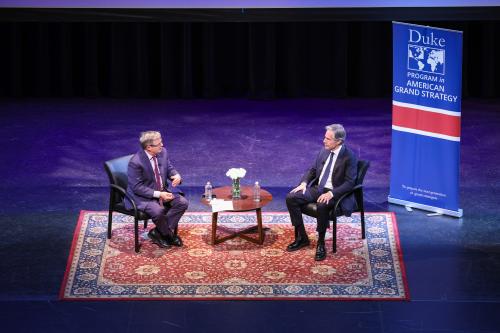
“I think we all have these extraordinary formative experiences that resonate later in our lives. For me, that story was really more than anything else, the preparation for this job. It really instilled in me what I wanted to do, which was to try in some small way to continue that tradition of America being the last best hope on Earth.”
Antony J. Blinken, the 71st U.S. Secretary of State, shared the deeply personal history that anchors his worldview during his visit to Duke University. It was a moment that bridged the gap between high-level international strategy and the intimate, human drive to serve. This theme of personal commitment to public good resonated throughout the evening.
Blinken visited Duke University as the distinguished guest for the Duke Program in American Grand Strategy’s Fall 2025 Ambassador Dave and Kay Phillips Family International Lecture. The event was moderated by AGS Director Peter Feaver, who is a professor of political science and public policy. It offered Duke students, staff, and faculty a rare glimpse into the mechanics of modern diplomacy.
While the conversation touched on the complexities of geopolitical competition and the weight of executive decision-making, the Secretary returned frequently to a central thesis: the necessity of American engagement and the vital importance of public service.
He gets down on his knees and he says the only three words that he knew at that point in English that his mom had taught him before the war: ‘God Bless America and the G.I. lifted him into the tank, into freedom, into the United States.
Antony Blinken, 71st U.S. Secretary of State
Before diving into the intricacies of foreign policy, Feaver opened the dialogue by exploring the path that led Blinken to the State Department. It was a journey that was anything but linear.
Blinken spoke candidly about his early years living in Paris. He credited this experience with giving him a dual perspective on the United States. Moving to France at age nine allowed him to see his own country through the eyes of others. He described this vantage point as essential for any diplomat who wishes to understand how American policy is received abroad.
The emotional core of the evening came when Blinken recounted the story of his late stepfather. His stepfather was a Holocaust survivor from Bialystok, Poland. Blinken detailed his stepfather’s harrowing escape from a death march in Bavaria at the end of World War II and his encounter with an American tank in the woods.
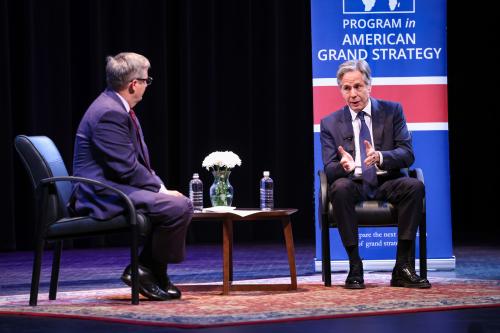
“He gets down on his knees and he says the only three words that he knew at that point in English that his mom had taught him before the war: ‘God Bless America,’” Blinken recounted. “And the G.I. lifted him into the tank, into freedom, into the United States.”
Diplomacy, Blinken argued, at its most fundamental level, is about human lives and the enduring promise of safety and freedom.
Feaver, leading the conversation, balanced these heavy themes with moments of levity and humanity. He playfully pressed the Secretary on his musical aspirations by noting Blinken’s “A. Blinken” (similar phonetically to Abe Lincoln) persona on Spotify.
“I was once hoping to be a successful musician,” Blinken joked. “I discovered that I was just missing one ingredient, which was talent. Nonetheless, I persisted.”
He recounted a wartime visit to Kyiv where he ended up on stage in a local bar with a Ukrainian military band. They performed Neil Young’s “Rockin’ in the Free World.” Blinken described the choice as an attempt to bring a moment of normalcy to a people under siege.
“It was a really important moment for people to just blow off a little steam,” Blinken said. The story underscored a subtle but significant aspect of soft power. It highlighted the ability to connect on a human level even amidst conflict.
I spent pretty much every day for a period of time from Oct. 7 to the end of our administration trying to end the war and trying to help those who are caught in this crossfire.
Antony Blinken, 71st U.S. Secretary of State
Blinken also pulled back the curtain on the internal mechanics of the U.S. government. Having served in both the National Security Council and the State Department, he offered a candid reflection on the famous bureaucratic aphorism that "where you stand depends on where you sit."
Despite this inevitable friction, he emphasized that integration across agencies is vital. He argued that modern threats are too multifaceted for any single agency to solve alone. Economic policy, military strategy, and diplomatic outreach must work in concert. This requires a level of coordination that transcends departmental rivalries.
Feaver guided the Secretary through a tour of the most consequential challenges facing the United States. Central to this discussion was the U.S. relationship with China.
Blinken pushed back on the binary notion that nations must only be friends or foes. He described the relationship with China as the most consequential and complex in the world. He outlined a strategy defined by three pillars: Invest, Align, and Compete.
He explained the Biden administration’s thinking about the need to invest in domestic strength, specifically citing infrastructure, semiconductor manufacturing, and scientific research.
Blinken also underscored the value of allied and partners to ensure the United States does not face global challenges in isolation. While the United States represents a sizable portion of the world’s GDP, that figure rises to nearly 60 percent when it includes major allies across Europe and Asia. These relationships, he argued, provide the necessary leverage to compete effectively on technology and military capability.
The discussion inevitably turned to the difficult decisions from his time at the State Department. Feaver asked the Secretary to reflect on the withdrawal from Afghanistan, the ongoing war in Ukraine, and the Israel/Gaza conflict.
Regarding Afghanistan, Blinken described the withdrawal as a painful but necessary strategic pivot. He argued that the status quo was unsustainable. Remaining would have required a massive surge of troops and inevitable casualties. The decision was essential to free up the strategic bandwidth required to focus on great power competition with China and Russia.

On Ukraine, Blinken highlighted the role of American intelligence and coalition building. He noted that the United States had distinct intelligence regarding the invasion. The subsequent rallying of a global coalition ensured that Russia's aggression resulted in a strategic failure, avoiding a quick Ukrainian collapse.
Feaver also pressed the Secretary on the conflict in Gaza, specifically asking whether there was anything he could have done differently in hindsight.
“I spent pretty much every day for a period of time from Oct. 7 to the end of our administration trying to end the war and trying to help those who are caught in this crossfire,” Blinken responded.
He described the administration's strategy as being driven primarily by ensuring an attack like Oct. 7 never happened again, and focusing heavily on securing a ceasefire and a deal for the release of hostages.
Reflecting on the human toll, Blinken offered a somber conclusion to this portion of the conversation. “The one thing I wish more than anything else is we could have gotten [to a ceasefire agreement] sooner and with less suffering along the way,” he remarked.
In closing, Blinken offered a final charge to the students in the room – the future diplomats, analysts, and leaders. He invoked the classic film It's a Wonderful Life as an analogy for American foreign policy.
He asked the audience to imagine a world without American engagement. In his view, if the United States does not lead, one of two things would happen. Either another power with hostile interests will take the helm, or no one leads. The latter results in chaos.
Despite the grueling hours, the criticism, and the weight of the responsibility, Blinken insisted that public service remains the most fulfilling path available.
“It really instilled in me what I wanted to do, which was to try in some small way to continue that tradition of America being the last best hope on Earth,” he reiterated.
For the Duke community in attendance (particularly students looking to enter this field), the Secretary’s visit was a testament to the complexity, burden, and profound necessity of the work that lies ahead.