Image

“Public policy at its best shapes spaces, systems, and cultures that bring out the best in us – including encouraging us to have one another’s backs.”
For John-Paul Smith, that belief is both a personal philosophy and a professional mission. As founding executive director of North Carolina Education Corps, Smith has spent the past five years leading a statewide effort to ensure that every child in North Carolina gets the support they need to learn to read. “Every year, nearly 3.6 million children are born in the United States. By fourth grade, nearly 40 percent of them cannot read at or above grade level. This is bad for them. It’s bad for the economy. And it’s bad for national security. Yet we know at least one thing to do about it: partner with schools to implement high-impact tutoring.”
The work of North Carolina Education Corps builds directly on values shaped at Sanford: inspire excellence, value relationships, and work smart with the conviction that people and purpose belong at the center of policy.
Smith describes his years at Sanford as deeply formative. “Sanford is a big part of me,” he said. “And every time I go back, it feels like going home to a loving family.”
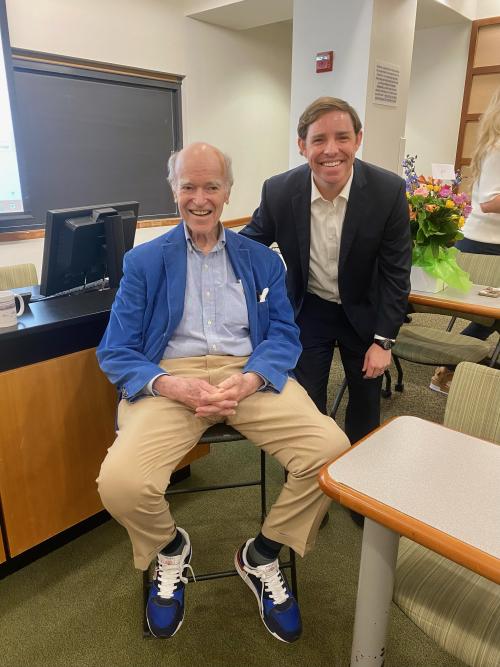
As a teaching assistant for Tony Brown’s Enterprising Leadership class, Smith absorbed a lesson that guides him today: act with thoughtful urgency. “Tony models the way. He shows us what it looks like to take strong-hearted, values-based action,” he said. “One of North Carolina Education Corps’ values is to collaborate and act with thoughtful urgency. Tony’s example is now part of our DNA.”
He also credits Professor Joel Fleishman for inspiring his belief that a small, dedicated community can create widespread opportunity. “It’s no surprise that Joel’s field of study was philanthropy – a word that literally means ‘the love of humanity.’ I came to Sanford eager to engage with a community of individuals on a mission to make positive change in the world. That’s the world that President Sanford envisioned and Professor Fleishman built for the Sanford School,” Smith recalled. “Sanford nurtures an environment where humans support humans. In the policy world, people talk about social safety nets. Sanford is that, but much more: it’s a social springboard.”
Before arriving at Duke, Smith had spent nearly a decade in North Carolina civic life, working with organizations like the Institute for Emerging Issues, United Way of the Greater Triangle, and the Governor’s Office. At Sanford, those experiences converged. During his summer internship, he helped create the North Carolina Summer Fellows program to connect college students with public-service projects inside state government.
That project informed North Carolina Education Corps, which launched in the summer of 2020 to engage North Carolinians to support schools and students in the midst and the wake of the pandemic. Americans are better at responding to wolves at the door than we are at responding to termites in the basement. Given my experience with civic engagement projects and launching NC Summer Fellows, I happened to be somewhat prepared to help stand up North Carolina Education Corps when COVID hit,” Smith said.
The organization began by mobilizing contact tracers and digital learning navigators, then quickly turned its focus to high-impact literacy tutoring as students returned to classrooms. “COVID poured fuel on the fire of low student achievement. Student reading and math test scores measuring basic competency in those subjects have been declining since about 2013. They fell toward the basement during COVID. So, we embraced what is shown to accelerate reading growth for students struggling to master foundational literacy skills: evidence-based high-impact tutoring,” he said. “That’s tutoring during the school day, three times a week, 30 minutes a session, with groups of four students or fewer with the same tutor throughout the school year. We’ve set out in partnership with schools to make it accessible at scale.”
Launching a nonprofit is not an individual sport. It’s a team sport. Being able to pull together a bipartisan board in a hyperpolarized environment and do something good for kids has been incredibly meaningful. We are out to unlock opportunity through community.
John-Paul Smith (MPP'20)
Since its founding, NC Education Corps has supported thousands of young learners across the state. What began as a small pilot has become a network of partners spanning more than thirty counties. “While low reading scores are a problem nationwide, we wanted to start where we are. Out of the 3.6 million new babies born across the country each year, approximately 120,000 of them are born in North Carolina. If you lined up all the K-4 students struggling to meet grade-level reading benchmarks in North Carolina, the line would stretch from Duke University in Durham to The Duke Endowment in Charlotte,” Smith explained. “So the question is, how can we make that line shorter? What can help them catch up?”
The Corps now places and supports hundreds of trained tutors who work directly with students in kindergarten through fifth grade. “Corps members” focus on building literacy through consistent, evidence-based instruction and personal connection. Smith calls it “a simple idea that requires a lot of coordination.”
“The majority of school districts experience the same pain points when implementing high-impact tutoring on their own: they don’t have time to recruit tutors, they don’t have the capacity to train and coach them, and they don’t have the systems in place to measure and improve the impact tutors have on student growth,” he said. “They’re up to their eyeballs with other work. So, we partner with them to recruit, train, coach, and progress monitor high-impact tutors so their students can get the support they need to accelerate their learning.”
By partnering with schools, NC Education Corps has filled a critical gap. To date, nearly 1,300 Corps members have tutored more than 22,000 students, primarily in low-income or low-performing elementary schools. The tutors work part-time, are employed by schools, and come from varied backgrounds. Many are retired teachers, parents, or caregivers, and a few are college students who see tutoring as a way to test drive a career in education.
For Smith, numbers matter, but the real impact is human. “I love visiting schools and seeing corps members, kids, and educators bring out the best in one another,” he said. “It reminds you why you’re doing the work.” He recalled a tutor who brought a local newspaper into class and watched students marvel at holding real printed pages, covering real stories from their small town for the first time. “It’s those moments that show the power of connection,” he said.
Smith sees the work as more than an education intervention—it is a civic act. “Launching a nonprofit is not an individual sport. It’s a team sport,” he said. “Being able to pull together a bipartisan board in a hyperpolarized environment and do something good for kids has been incredibly meaningful. We are out to unlock opportunity through community.”
He defines leadership by describing a set of behaviors, grounded in values and beliefs. “For us, that includes respect for the ones you love, and empathy for the ones you are still getting to know,” he said.
We all have unique gifts and skills and therefore unique ideas that need to come into play. Sometimes we sit on the sidelines because we don’t know how to get involved. Education Corps creates an opportunity for people to get involved.
John-Paul Smith (MPP'20)
Smith says Sanford’s culture of connection continues to influence how he leads. He often recalls how the building’s design encourages people to meet by chance. “The architecture of the school builds community in creative ways,” he said. “It’s intentionally designed so that people from different backgrounds bump into one another. Those strategic collisions help build understanding.”
That sense of design and purpose shapes his statewide leadership. “Bringing people together from different backgrounds around a common purpose is what this work is about,” he said. “If you don’t learn to read, then it’s really hard to read to learn. Helping little kids master their foundational reading skills so that they become readers, and then they become leaders—that’s the seed we’re planting.”
Smith describes NC Education Corps as an education, economic, and civic engagement initiative. “Once you learn to read, you can read to learn. Once you develop interest and capability in learning, the sky’s the limit for you,” he said. “So we’re helping kids develop their foundational skills and confidence as learners, which is critical to unlocking their potential in career and life, and at the same time, we’re building civic capacity. Every Corps member who serves gains a deeper understanding of what’s happening in our schools and why it matters.”

That idea ties back to his Sanford experience. “If you’re a citizen, you’re involved in public policy, whether you know it or not and whether you choose to participate actively or not,” he said. “We all have unique gifts and skills and therefore unique ideas that need to come into play. Sometimes we sit on the sidelines because we don’t know how to get involved. Education Corps creates an opportunity for people to get involved.”
Reflecting on Sanford’s legacy, Smith recalled researching Terry Sanford’s life for an exhibit marking his 100th birthday. “What came through in that research was Sanford’s focus on outrageous ambitions,” he said. “This is the time for Sanford alumni to lean into that outrageous ambition. The world can seem dark if all we do is read national and international news, but now is the time to lead in the way we learned from Sanford.”
For John-Paul Smith, that ambition looks like practical service rooted in empathy. “It’s a privilege to be a part of the Sanford community,” he said. “It’s now on us to pay it forward. Start where you are. Act with thoughtful urgency. Be a social springboard.”
This article was posted in the Sanford Alumni Memo, to stay informed about Sanford alumni events, news and profiles email Alex Dodds alexander.dodds@duke.edu to sign up.