Image
The world’s superpowers were headed towards conflict.
Initial reporting showed a fuel slick spreading across the Labrador Sea near Greenland. Military vessels from China, Russia, and the U.S. hurtled toward an unfolding crisis, as news outlets raced to cover it. The situation threatened environmental damage, territorial disputes, and a potential global conflict. The United States needed to respond.
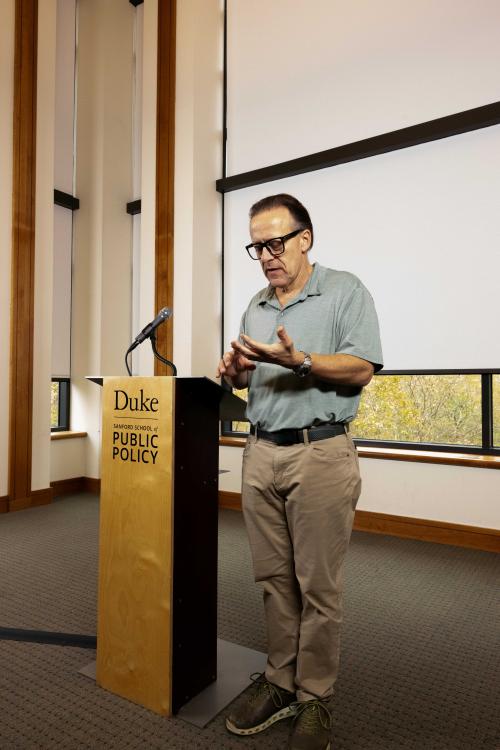
Except none of it happened in the Arctic Circle. It played out in Sanford 201, where students in Tim Nichols’ Public Policy 505 course stepped behind a podium and faced a room full of faculty and staff acting as foreign correspondents. They delivered a live briefing on a fictional Arctic emergency that felt uncomfortably real. The simulation capped a semester that moved quickly from constitutional basics into the pressure-filled world of national security decision-making. It also offered a clear look inside one of Sanford’s most distinctive learning environments.
Nichols, a Visiting Professor of the Practice and Director of Graduate Studies for the Master of National Security Policy program, builds the course around the tools and habits that shape decision-makers. Students explore ethics, strategy, and communication. They learn the structure of the United States national security apparatus and examine how presidents approach risk and information. Writing assignments, case studies, and team debates push them to apply each lesson. The simulation brings it all together.
“Through their educational journey at the Sanford School, students are steeped in the tools of critical thinking and policy analysis. Our simulated press conference exercises the necessary skills of conveying the results of their analysis and a subsequent policy decision to the public. Students receive a crisis scenario, a policy task, and strategic communication guidelines from the White House. As a small team, they develop an announcement script and prepare for questions from an inquisitive international press. The purpose of the event is to record and assess the students’ effectiveness in strategic communications, so they can view how they appear under the bright lights and in front of a rigorous press corps,” Nichols explained.
From the first weeks, students realized this course would not stay in the realm of theory for long. Counterterrorism and Public Policy (CTTP) Fellow John “Jens” Boehnert described the rapid shift into complex, real-world analysis. “I expected a strong academic treatment of national security, but I did not expect how quickly we would move beyond theory into the complicated realities of practice. Professor Nichols built the course around messy, contemporary issues instead of clean textbook cases, so every discussion felt extremely relevant and applicable,” he said.
The course draws students from across Sanford, including undergraduates, master’s students, and CTTP fellows with years of service. This mix creates a layered learning environment where experience and curiosity meet.
CTTP Fellow Bruce Roett valued this dynamic. “It has been really interesting to listen to the undergraduates who have such bright ideas, the master students who plan to enter the policy making world who have such advanced views and theories on foreign policy, to practitioners like DOS Special Agent Ron Roof, FBI Analyst Lisa Allenbach, Intelligence expert COL Amanda Hughes, and Former CJCS GEN (R) CQ Brown and their years of experience, to my fellow Army senior leaders and their unique perspectives, to Professor Nichols himself, with his wealth of experience and stories from national security decision making.”
I expected a strong academic treatment of national security, but I did not expect how quickly we would move beyond theory into the complicated realities of practice. Professor Nichols built the course around messy, contemporary issues instead of clean textbook cases, so every discussion felt extremely relevant and applicable.
John “Jens” Boehnert, CTTP Fellow 2025-2026
Nichols often begins class with crisis vignettes. Students receive only a few facts about a fast-moving national security problem and must recommend next steps. Roett noted that these exercises exposed the difficulty of real-time decisions. “The responses we generated as a class and the end of the exercise reveal what was recommended to the President and what he actually decided were always very interesting and went a long way in demonstrating how complex with third and fourth order effects these decisions have,” he said.
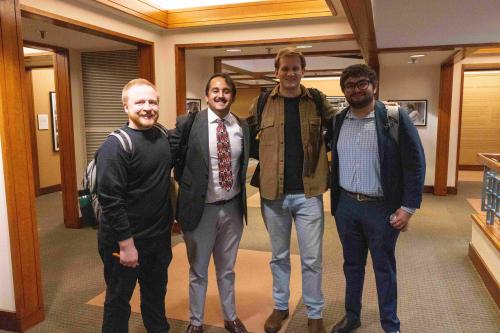
Senior Abigail Bergan found that the course grew more collaborative over time. “Across age demographic, life experiences, and interests, as time went on, I felt like we got better and better at learning from each other and collaborating, both inside and outside of class,” she said. She also pointed to the trust and effort that Nichols brought to the classroom. “I was surprised by just how much effort Professor Nichols put into the class, and how cohesive our group became across the semester.”
Writing assignments play a central role in the course. Students craft op-eds, policy memoranda, and briefing materials that force them to prioritize clarity and precision. “Writing policy memos with tight word limits forced me to focus on what truly matters and to be explicit about costs, risks, and implementation,” Boehnert said.
Roett found that these discussions challenged his long-held assumptions. When the class debated the United States' No Concessions policy for hostage taking, he said, “This exercise truly forced me to examine my own deeply held beliefs and values.”
Bergan noted how these assignments translated theory into real pressure. “It was such a phenomenal way to put our in-class knowledge into practice and test my book knowledge against my ability to execute that knowledge,” she said. “The whole class period created a very realistic sense of pressure, and the fast pace helped emphasize some of the key themes of the course.”
The press conference was one of the most unique and formative experiences I have had in a classroom at Duke. Being put on the spot to deliver a briefing in front of an audience of strangers was such an unexpected and valuable experience.
Senior Abigail Bergan
By the final weeks, students were ready for the simulation that serves as the centerpiece of the course. Four student teams each selected two briefers, one representing a military general and one representing the senior United States diplomat in Copenhagen. Each pair gave opening remarks on the unfolding Arctic crisis before taking questions from a press corps determined to press for clarity on every detail.
The scenario involved a fictional oil spill in the Labrador Sea and the rapid deployment of United States forces to Greenland. It required students to integrate environmental concerns, alliance dynamics, Arctic geopolitics, and the information demands that follow any high-visibility military response.
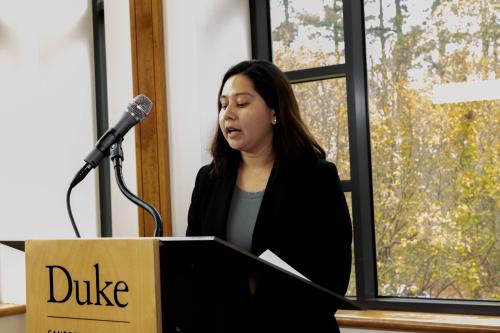
For Bergan, the press conference stood out as one of the most meaningful experiences she has had at Duke. “The press conference was one of the most unique and formative experiences I have had in a classroom at Duke,” she said. “Being put on the spot to deliver a briefing in front of an audience of strangers was such an unexpected and valuable experience.”
Samanyu Gangappa, a third-year undergrad, echoed those sentiments, "Professor Nichols's class was just one of those classes that stands out — and it's all about the experience. I was surprised at how experiential it was, and that really was the core of his class. The press conference was really just one example of how above and beyond he goes for us."
Roett said the simulation brought the idea of grand strategy into sharp focus. “It becomes a game of priorities and trade-offs,” he said, describing strategy as a shifting Venn diagram where interests move and overlap in real time.
Mentorship plays a central role in the learning environment. Roett said guiding younger students helped him reflect on his own experience in uniform. “We have a saying in the Army that the number one job of any leader is to make more leaders,” he said. “Any encouragement or nugget of information I can pass on to them encourages me that when I finally pass the baton and retire, it is in better hands.”
Gangappa benefited as one of those future leaders. "Having the CTPP fellows' expertise compounded the benefits of the course, especially as I got to know several of them on a personal level. They're sitting right next to you, interrogating your positions and telling us how they think about the same problem based on their experiences. It's one thing to listen to them, but it's different to have them sitting next to you."
Bergan said the course also clarified her own path. “It definitely solidified my interest in working in national security and defense policy,” she said. She credited Nichols with creating opportunities to pursue her interests and strengthen her toolkit for the future.
And ultimately, this sentiment is the core of National Security Decision-Making (Pub Pol 505), which represents Sanford’s model of informed, pragmatic courses; the Arctic crisis may have been fictional, but the lessons were real.